Culture & Ceremonies

A faith that dances, a community that shares everything, and ceremonies unchanged for centuries.

Lalibela is not a museum. It is a living spiritual community where priests still chant in Ge'ez at dawn, pilgrims walk for days to attend all-night vigils, and the coffee ceremony remains a daily act of connection. Three great celebrations define the year — Genna (Christmas), Timkat (Epiphany), and Meskel (Finding of the True Cross) — each drawing thousands of white-robed worshippers into the rock-hewn churches for ceremonies that have barely changed since the 12th century.

The Great Celebrations

Ethiopia's Orthodox calendar structures the entire rhythm of life in Lalibela. Three ceremonies stand above the rest — each a pilgrimage destination in its own right, each an experience that will stay with you forever.

Genna — Ethiopian Christmas (January 7)

Forget everything you know about Christmas. Genna is not about gifts or trees or shopping — it is about prayer, fasting, and the collective celebration of something bigger than any individual.

Preparation begins 43 days before Christmas with Tsome Nebiyat, the Fast of the Prophets. For six weeks, the faithful eat no meat, no dairy, no eggs — only vegan meals, consumed once per day, never before 3 PM. By the time Christmas Eve arrives, the spiritual tension is extraordinary.

Then the vigil begins.

On the evening of January 6, the rock-hewn churches fill with worshippers. Each pilgrim receives a twaf — a beeswax taper — and as the sun sets over the Ethiopian highlands, thousands of candles ignite in the darkness. The chanting starts. Drums beat. Sistrums rattle. And it does not stop until 9 AM the next morning.

At Bet Maryam (House of Mary), the ceremony reaches its peak. Priests position themselves on the rock rim above the courtyard — symbolizing the angels in heaven — while those below represent the shepherds on earth. A responsive liturgical dialogue echoes through stone corridors carved eight centuries ago. The priests sway in unison, rattling their tsenatsil (sistrums), chanting hymns composed by Saint Yared in the 6th century. Hundreds of deacons perform King David's dance — elaborate ritual movements accompanied by cymbals and drums.

Approximately one million pilgrims descend on Lalibela for Genna. Many walk for days. They wrap themselves in white netela shawls and crowd the churches so densely that movement becomes impossible. You stand in a sea of white, surrounded by candlelight and prayer, and you understand why people call this the most powerful spiritual experience on Earth.

On Christmas Day itself, the town celebrates with Ye Genna Chewata — a traditional game similar to field hockey, played with sticks and a leather ball. Legend says it represents the tools used by the shepherds who witnessed Christ's birth.

"You don't watch Genna. You are absorbed into it. The vigil erases every boundary between you and the community around you."

Timkat — Ethiopian Epiphany (January 19)

Twelve days after Genna, Lalibela celebrates Timkat — the commemoration of Jesus's baptism in the River Jordan. If Genna is contemplative fire, Timkat is joyful water.

The three-day celebration begins on January 18 with Ketera (the eve), when traditional horns herald the start of festivities. The central event is the Tabot procession: the Tabot — a replica of the Ark of the Covenant, normally hidden deep within each church's Holy of Holies — is reverently wrapped in silk and rich cloth and placed on the head of the most senior priest. Each church sends its own procession.

The priests march in colorful robes, sheltered by embroidered ceremonial umbrellas, accompanied by chanting, drumming, and ululation. The processions converge at a body of water — in Lalibela, the Yordanos stream that runs through the church complex, itself named for the River Jordan.

The Divine Liturgy begins around 2 AM on January 19. The water is blessed towards dawn, then sprinkled on the congregation. Some participants wade in fully, symbolically renewing their baptismal vows. By noon, the Tabots are returned to their churches in a colorful procession of spirited dancing and feasting.

Timkat in Lalibela is considered the equivalent of the Hajj for Ethiopian Orthodox Christians. UNESCO inscribed it on the Representative List of the Intangible Cultural Heritage of Humanity in 2019.

Meskel — Finding of the True Cross (September 27)

This is the ceremony Antonin experienced firsthand — and it changed everything.

Meskel (Amharic for "cross") commemorates the 4th-century discovery of the True Cross by Empress Helena. According to tradition, Helena had a revelation in a dream: build a bonfire, and the smoke will reveal where the Cross is buried. She ordered the people of Jerusalem to gather wood, added frankincense, and lit the pyre. The smoke rose to the sky and descended to the exact spot where the Cross lay hidden.

In Lalibela, the celebration centers on the Demera — a massive bonfire decorated with yellow Meskel daisies (Adey Abeba). When darkness falls, the Demera is lit. The direction the bonfire falls is believed to predict the fortunes of the coming year. Throughout the town, people light smaller torches called chibo in their neighborhoods.

After the fire dies, the faithful collect charcoal and mark their foreheads with the shape of a cross.

Antonin stood among thousands that night — bonfires against the highland sky, singing that seemed to come from the earth itself, children running between the flames, priests chanting through the darkness. It was during Meskel that the idea for this project was born. UNESCO inscribed Meskel in 2013 as Ethiopia's first Intangible Cultural Heritage.
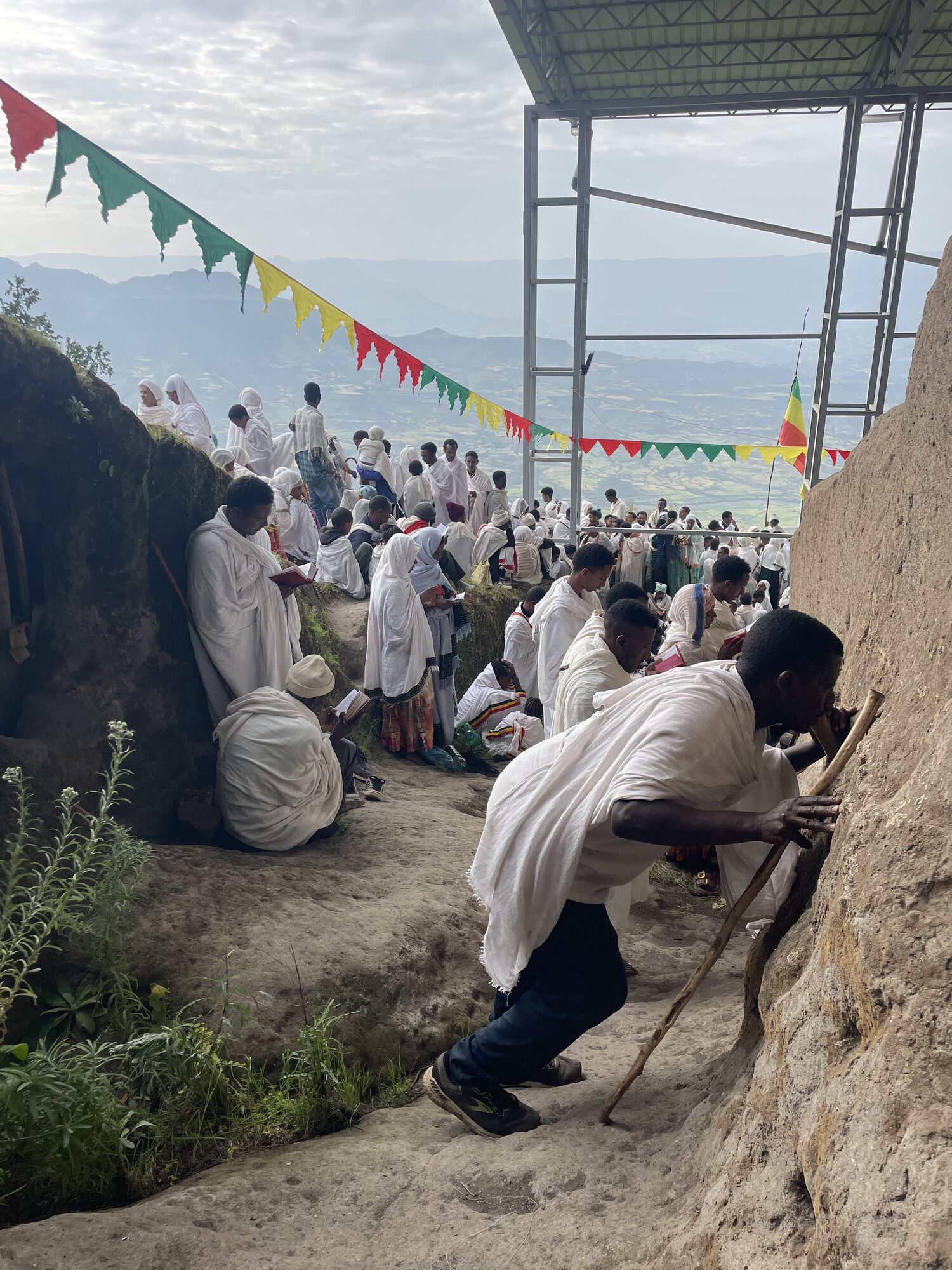
Worshippers gathered on a hillside during a ceremony in Lalibela

Food & Coffee

Eating Together

Ethiopian food is extraordinary and extraordinarily affordable. A communal plate of injera — spongy sourdough flatbread made from teff grain — arrives topped with stews, lentils, and vegetables. You tear off a piece, scoop up the food, and eat with your right hand. There are no individual plates. Everyone shares.

The most beautiful tradition is gursha — the act of taking a morsel of food wrapped in injera and placing it directly into another person's mouth. Elders and guests receive the first gursha as a sign of respect. The gesture is reciprocal: when someone honors you with gursha, you return it. The word means "mouthful," but what it really means is: I see you. You matter.

A full meal costs $1–2. Fresh juice, $0.50–1. Beer, $1. Ethiopia is one of the most affordable countries on Earth for visitors — and the food is among the best.

The Coffee Ceremony

Ethiopia invented coffee. The legend goes that a 9th-century goat herder named Kaldi, in the Kaffa region of southwestern Ethiopia, noticed his goats dancing with unusual energy after eating red berries from a certain bush. He brought the berries to a local monastery, where monks discovered that a beverage brewed from them kept them alert through long nights of prayer. From Kaffa, coffee conquered the world — and the word "coffee" itself derives from the region's name.

The Ethiopian coffee ceremony is not a transaction. It is a gift of time.

It begins with the hostess spreading fresh grass and small yellow flowers on the floor. Frankincense is burned to clear the air of bad spirits. Then green coffee beans are roasted slowly over an open flame — the host wafts the rich aroma toward each guest. The beans are ground by hand using a mukecha (wooden mortar and pestle), then brewed in a jebena — a round-bellied clay pot with a narrow spout, its design unchanged for centuries.

Coffee is served in three rounds, each with its own name and meaning:

1

Abol

The first round. The strongest. It represents awakening and the beginning of connection — the moment you open yourself to the people around you.

2

Tona

The second round. Slightly lighter. It reflects continuity — the deepening of bonds between those sharing the cup.

3

Baraka

The final round. The lightest, and the most blessed. Baraka means "blessing" — it signifies goodwill, peace, and harmony. To stay for all three rounds is to honor your host fully.

The ceremony takes 30 to 60 minutes. To decline coffee in Ethiopia is to decline connection itself. The cost? About $0.30. The value? Immeasurable.

Fasting Season — The World's Best Vegetarian Food

The Ethiopian Orthodox Church mandates 180 fasting days per year for laypeople — and up to 252 for clergy. Fasting means no animal products at all: no meat, no dairy, no eggs. Every Wednesday and Friday is a fasting day, plus major periods like the 55-day Lent (Hudadi) and the 43-day Advent fast.

The result? Centuries of fasting have produced some of the most extraordinary vegetarian cuisine on the planet. Spiced lentil stews, chickpea dishes, sautéed vegetables with berbere spice, all served on injera. When you visit during a fasting period, the food is exceptional — and entirely plant-based.

Daily Life

Life in Lalibela moves to its own rhythm — literally. Ethiopia runs on a different clock and a different calendar from the rest of the world.

The Ethiopian clock starts at sunrise. When the sun comes up at what Westerners call 6 AM, Ethiopians call it 12 o'clock. To convert, add or subtract six hours. Near the equator, sunrise and sunset happen at nearly the same time year-round, so the system is perfectly logical — the day begins when light begins.

The Ethiopian calendar has 13 months: twelve months of 30 days each, plus a short 13th month called Pagumen (5 days, or 6 in a leap year). The Ethiopian year is 7 to 8 years behind the Gregorian calendar. Ethiopia's tourism board captures it perfectly: "13 months of sunshine."

In Lalibela, sacred songs, stone bells, drums, and incense are a daily occurrence — not a tourist attraction. White-clothed pilgrims file through the rock-hewn churches every morning. Priests chant at dawn in Ge'ez, a language that has not been spoken in daily conversation for over a thousand years but lives on in every liturgy.

The town is clean. The people are respectful. Children play freely in the streets — curious, autonomous, full of laughter. Donkeys carry goods along stone paths. Saturday is market day — the social event of the week, when farmers and traders descend from the surrounding hills.

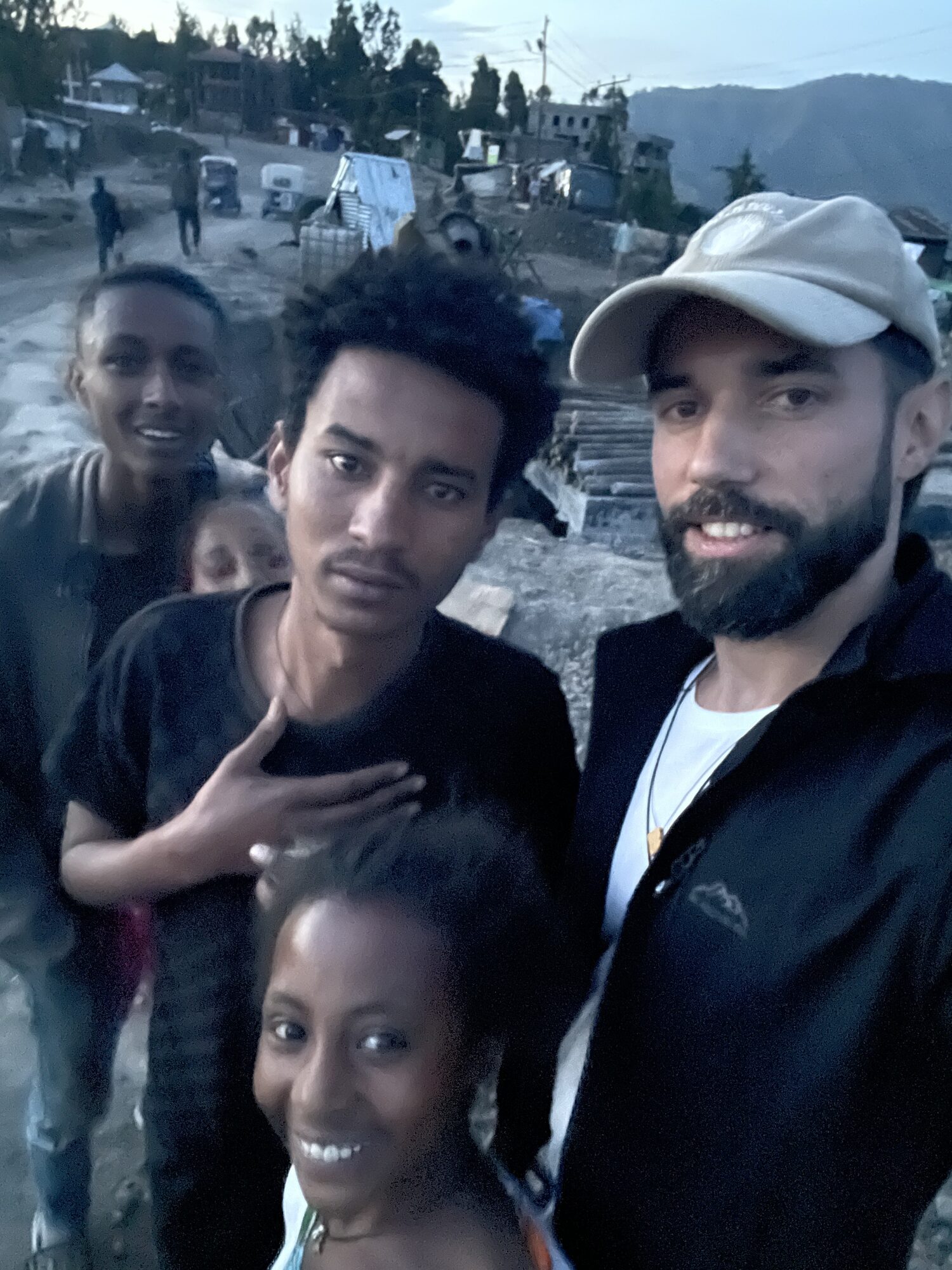
Local children and visitors in Lalibela town — warmth and connection

Community in Lalibela is not a concept. It is the air you breathe. Meals are shared from a single plate. Strangers are welcomed as guests. The elderly are honored. The gursha tradition — feeding someone with your own hand — extends beyond the dinner table into every interaction. People here take care of each other.

Ge'ez — The Language of Prayer

Walk into any church in Lalibela at dawn and you will hear something remarkable: prayers chanted in Ge'ez, an ancient South Semitic language that has been extinct as a spoken tongue for over a thousand years.

Ge'ez originated in the Kingdom of Aksum, with the earliest inscriptions dating to the 4th century. It belongs to the same Semitic family as Arabic and Hebrew, but it developed its own unique script — fidel — derived from Ancient South Arabian writing. That script is still used today to write Amharic, Tigrinya, and other Ethiopian languages.

The Bible was translated into Ge'ez between the 5th and 7th centuries, and here is what makes the Ethiopian tradition extraordinary: the Ethiopian biblical canon is the largest in all of Christianity. It includes books found in no other Christian tradition — the Book of Enoch (whose complete text survives only in Ge'ez), the Book of Jubilees, the Shepherd of Hermas, and others. When scholars want to study the Book of Enoch, they must read Ge'ez.

In the 6th century, the Aksumite composer Saint Yared created the musical system still used in every Ethiopian Orthodox church. He established three modes of chanting: Ge'ez for ordinary days, Ezel for fasting days and Lent, and Araray for major feasts. The dabtara — unordained scholar-singers who memorize vast hymnals and improvise within ancient melodic formulas — are the living keepers of this tradition.

During services, dabtara play the tsenatsil (sistrum), the kebero (drum), and the mequamia (prayer staff), swaying the staffs back and forth in an orchestrated movement called tirkeza. They divide into two facing lines and perform aquaquam — liturgical dance with stylized four-step patterns, each line moving forward and backward in turn. It is worship expressed through the body, a form of prayer found nowhere else in Christianity.

And every word they sing is in Ge'ez — a language no one speaks at home, but everyone speaks to God.

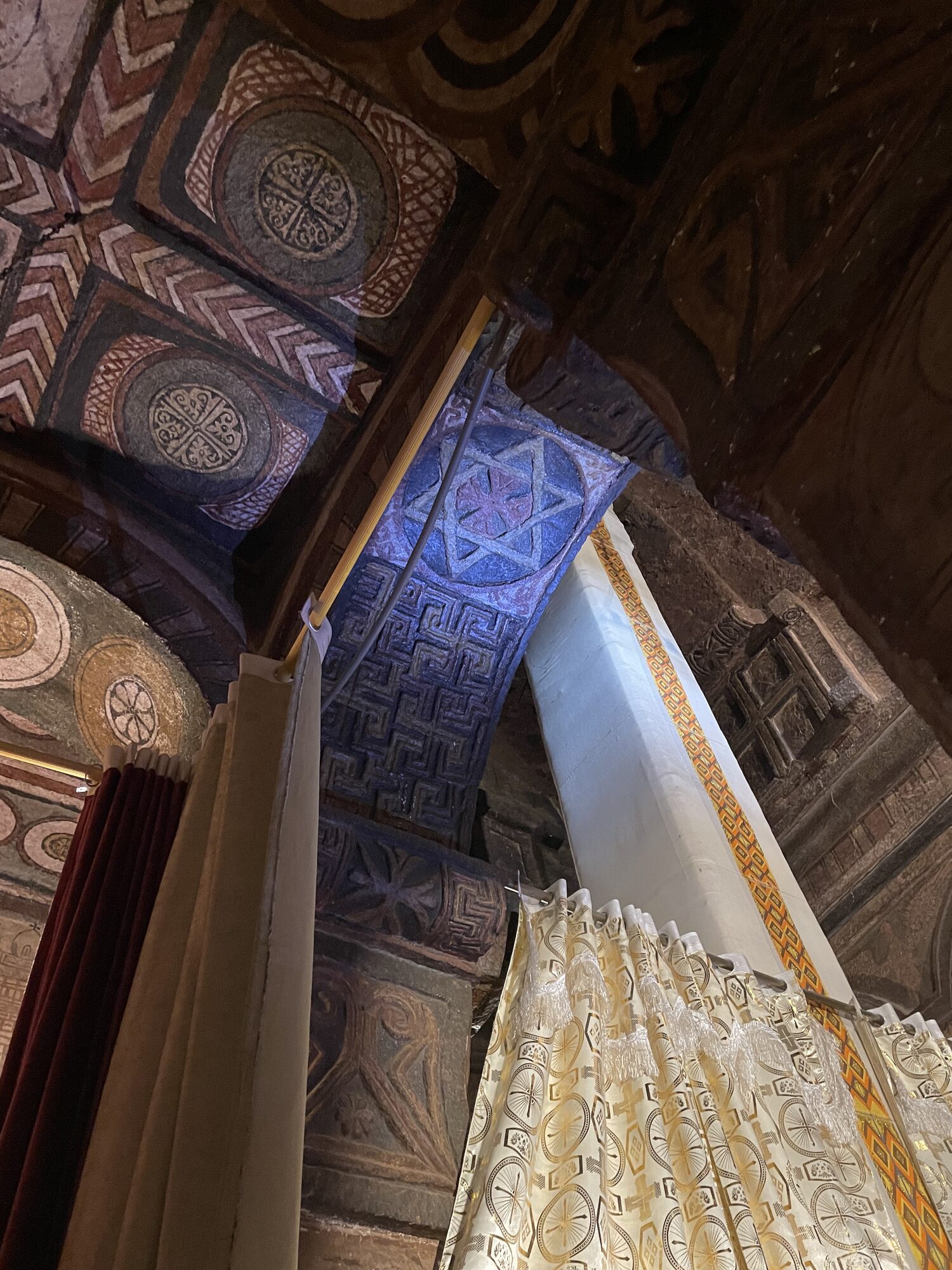
Painted ceiling with star patterns inside a Lalibela church

A Christianity Like No Other

Ethiopian Orthodox Christianity is one of the oldest Christian traditions on Earth — and one of the most distinct. If you arrive in Lalibela expecting something familiar, you will be surprised. This is Christianity before the European Middle Ages reshaped it, preserved in the Ethiopian highlands like an ancient seed.

The Ark of the Covenant

Every Ethiopian Orthodox church contains a Tabot — a replica of the Ark of the Covenant. A church is not considered consecrated until the bishop provides one. The Tabot is kept in the innermost chamber, accessible only to ordained clergy. Laypeople cannot touch it. Ethiopia claims the original Ark rests in Axum, brought by Menelik I, the legendary son of King Solomon and the Queen of Sheba.

Fasting as Devotion

180 fasting days per year for laypeople. Up to 252 for clergy. No meat, dairy, or eggs — ever, on a fasting day. Every Wednesday and Friday, plus Lent (55 days), Advent (43 days), the Apostles' Fast, and the Fast of the Assumption. Fasting is not deprivation here. It is the architecture of spiritual life.

Worship That Dances

Shoes off at the door. Men on the left, women on the right. Women cover their hair. Both Saturday and Sunday are holy. And the worship moves — drums, sistrums, prayer staffs, chanting, liturgical dance. This is embodied prayer, a tradition of physical devotion found nowhere else in the Christian world.

Experience It Yourself

No article can capture what it feels like to stand in a Lalibela church during an all-night vigil, or to share a coffee ceremony with people who treat a stranger like family. Some things you have to witness.

See also: The Sacred · Food & Coffee